Tuesday June 9th, 2026
For our latest edition of Success Reflects, we sat down for a conversation with Vishav Roma, CEO of Kinderzimmer UK, on building a high-quality nursery group from the ground up, one site at a time.
You’ve reached ten sites in the UK without a single acquisition. That’s rare in a sector where buy-and-build dominates. Why has organic growth been the right path for Kinderzimmer?
We wanted to build a great people culture from day one, this has always been the goal. When you build something from the ground up, every site reflects the values you set out with, the way you hire, the way you train, the way you talk to parents. You don’t inherit somebody else’s compromises, or strategy. Acquisitions can be a faster route to scale, but they can come with a lot of work to undo, if you are very particular on how you want your business to operate, and we didn’t want to spend our first few years going backwards to go forwards.
Kinderzimmer started in Germany. What’s genuinely different about running nurseries in the UK, and what assumptions did you have to let go of?
Honestly, fewer differences than people assume. We didn’t come in thinking we’d transplant the German model and hope for the best. The starting point was, let’s build a UK business, properly, on its own terms, but keep the Kinderzimmer DNA intact. We kept the heritage, but the UK business is its own business, independent of Germany. We have our own values which we have developed with our team here, the regulatory framework, the workforce, the way parents choose a setting, we approached as a UK business from day one.
A nursery is a people business. Staff are the experience. How do you build and keep a team that delivers what parents are paying for?
If you get the people right, and they’re genuinely happy at work, the rest tends to follow. We’ve made some deliberate choices to support that. No uniform. Fewer prescriptive rules. Instead, a clear framework around how educators show up for children and for each other. Within that framework, we encourage people to be themselves. It’s about authenticity, but with direction. In a heavily regulated industry, that balance matters. It signals trust that you value your team’s judgment while still providing clarity on expectations and standards. That’s the kind of environment people want to work in, and in this sector, retention is the quiet metric. Get that right, and parents can feel the difference.
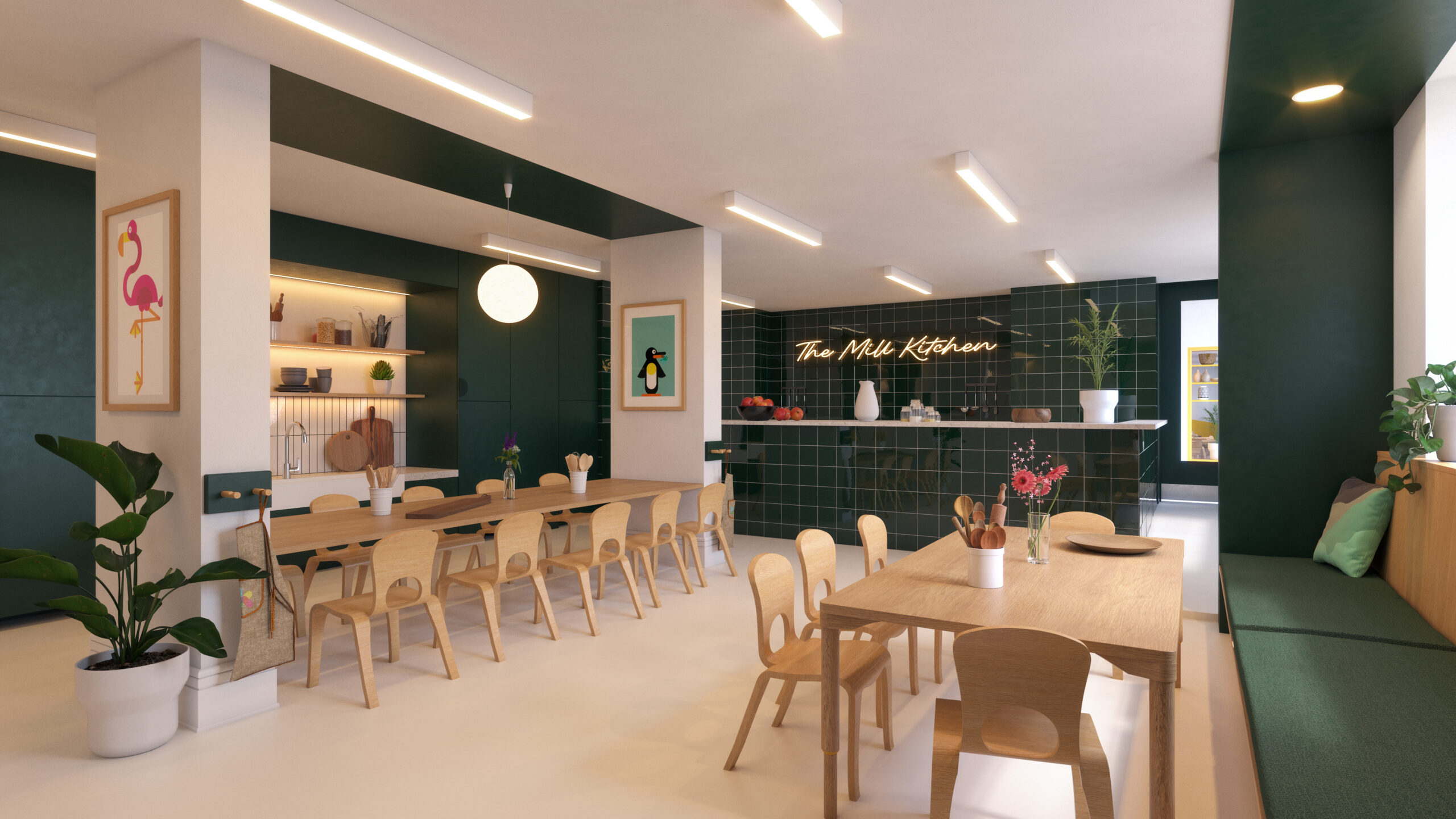
Demand for nursery places consistently outstrips supply, but that doesn’t mean every site works. How do you decide where to open?
It comes back to positioning. We’re a high-quality operator, that’s the proposition, so we need to be in locations where there’s genuine demand for that level of provision, and where the prevailing fee rate among competitors supports it. In practical terms, that means areas with two working professional parents, both in roles where quality of childcare is a real decision factor, not just convenience. Surrey and the South East fit that profile well. The opportunity isn’t everywhere. It’s in the catchments where parents are actively looking for something better than the default, as we have a clear portrait of our parents, so we can use a data-led approach to find the best locations to match our proposition.
Ockford Mill has been a passion project for two years. What kept you going when it looked difficult?
Opening in 2026, Kinderzimmer Godalming is the group’s tenth UK site, set in a restored 19th-century mill across two acres of woodland and powered by a micro-hydro system that harnesses energy from the lake’s weir, believed to be a first for a UK nursery.
The excitement of doing something different in the sector. Ockford Mill is the kind of site that doesn’t get built very often, and certainly not by nursery operators. There’s a version of this business that just opens more conventional sites and grows steadily, and there’s nothing wrong with that. But the reason we’re here is to raise the bar. To trailblaze a bit. Show what’s possible. When something is hard, that’s usually a reasonable sign you’re doing it.
Is there a decision in the last few years you’d make differently with hindsight?
Onwards and upwards. You can spend a lot of time relitigating decisions, but you make every decision with the information you had at the time. The discipline is to make the next one better.
Where do you want Kinderzimmer to be in five years, and what would have to be true to get there?
A base case of thirty sites by 2030, and recognised as the highest-quality provider in the UK. Those are the two markers. For that to happen, the focus has to stay on the teams: that they feel safe, that they feel happy, and that they have what they need to do the best work of their careers. Get that right and the rest follows. Children thrive. Parents stay. Sites perform. Growth is an output, not an input.